A prepaid Visa that turns your crypto into everyday spending, with a tier system that rewards bigger lockups
 Available in US
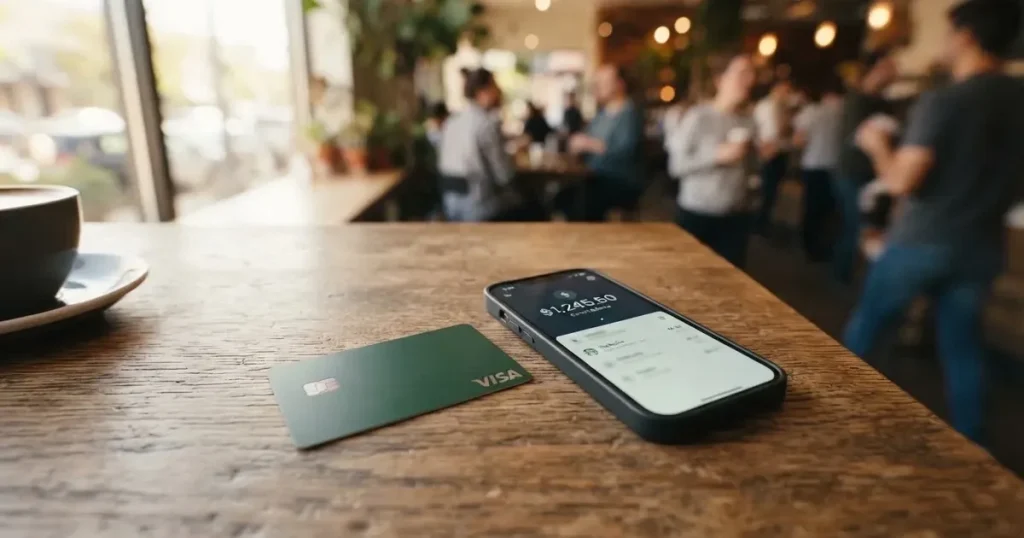
The Crypto.com card is a prepaid Visa that converts your crypto balance into local currency at the point of purchase, then hands you a small cashback in CRO token for every swipe. The headline is the tier system: lock up more of Crypto.com’s CRO token, climb through Midnight, Ruby, Jade, Icy and Obsidian, and your everyday cashback climbs with you, from nothing at the base tier to 4.5% at the top.
Conditions are current as of October 28, 2026.
That single design choice explains almost everything about the card. It is built for people who already hold CRO, or who are willing to buy and lock it, and who treat the card as one part of a wider Crypto.com account rather than as a standalone product. If that sounds like you, the rewards are competitive. If it does not, you will spend a monthly fee for benefits you never unlock.
Verdict: 7.0 out of 10
The Crypto.com card earns a 7.0 out of 10 in this review. The score reflects a product that is well built and widely available, but that comes with a structure that punishes anyone who does not commit to the ecosystem.
| Criterion | Mark | Why it scored that way |
|---|---|---|
| Who can get it | 8 / 10 | Issued across the US, 31 European countries, Singapore, Canada, Australia, the UK and Brazil (as a USD card for use outside Brazil), one of the broadest footprints of any crypto card. |
| Cost | 6 / 10 | Subscription tiers Free, USD 4.99 a month, and USD 29.99 a month in the US (Europe issuance EUR 4.99 for Midnight, card top-up 1%, ATM 2% above the free allowance, FX 0.2% in the EU/UK and 2.0% outside on the Midnight tier). |
| Top-up options | 6 / 10 | You can top up from your Crypto.com Crypto Wallet, Cash Account or another debit or credit card, but crypto must be converted to fiat before it lands on the card. |
| Reliability and complaints | 6 / 10 | The card is issued by regulated banks and e-money institutions in each region, but Crypto.com’s overall Trustpilot rating is 2.0 out of 5 from 9,493 reviews, with 72% of those one star. |
| Everyday use | 9 / 10 | Prepaid Visa with Apple Pay, Google Pay and Samsung Pay support (availability varies by region), a free ATM allowance of EUR 200 a month at the Midnight tier in Europe, and a virtual card available on approval. |
| Total | 7.0 / 10 |
The card suits residents of Europe and Singapore who want tiered crypto rewards, who already hold or are willing to buy CRO, and who pay for most things with a card rather than cash. It is the wrong fit for someone who treats their wallet as a one-off, who expects free spending in any currency, or who does not want to commit to a subscription.
Who will they give you the card
The card is issued by a different regulated entity in each region, and that issuer is the one running identity checks, holding your balance and standing behind the programme. Crypto.com itself is the brand, the app and the programme manager.
The issuer you get depends on your residential address, not (as far as the public pages say) on your citizenship. The card is available in:
- the United States, where it is issued by Community Federal Savings Bank, a Member FDIC bank operating under a Visa U.S.A. licence
- Europe (31 countries), issued by Foris MT Limited, a Malta-based e-money institution
- Singapore, issued by Foris Asia Pte. Ltd., which holds a Major Payment Institution licence from the Monetary Authority of Singapore
- Canada, where the card is offered by Foris, Inc. and issued by Digital Commerce Bank
- Australia, issued by Foris GFS Australia Pty Ltd, an Australian Financial Services Licence holder
- the United Kingdom, issued by ForisGFS UK Limited, an e-money institution authorised by the Financial Conduct Authority but not covered by the Financial Services Compensation Scheme
- Brazil, where a USD-denominated card is issued by Foris MT for use outside Brazil
The 31 European countries, as listed in a European help article from 20 July 2026, are Austria, Belgium, Bulgaria, Croatia, Cyprus, Czech Republic, Denmark, Estonia, Finland, France, Germany, Greece, Hungary, Iceland, Ireland, Italy, Latvia, Lithuania, Luxembourg, Malta, Netherlands, Norway, Poland, Portugal, Romania, Slovakia, Slovenia, Spain, Sweden, Switzerland and the United Kingdom.
Crypto.com is not a bank. In Europe and the UK the issuer is an e-money institution, which means your card balance is e-money rather than a deposit, and it is not protected by deposit guarantee schemes.
Unofficial reporting (CryptoCardHub, August 2026) lists Russia among a set of ten restricted countries, alongside Afghanistan, China, Cuba, Iran, North Korea, Somalia, Sudan, Syria and Yemen. That same source notes the listing is not internally consistent, because Sudan also appears in Crypto.com’s “available” list. The official pages do not publish a restricted-country list, so treat this as unofficial and unconfirmed by the card.
The card is a prepaid Visa. It is not linked to your bank account, and you must top it up before you can spend. The currency is the local currency of the issuer, which in practice means EUR in Europe, CAD in Canada, and USD in the US and Brazil. Whether you can hold a multi-currency balance on the card is not stated on the public pages.
How to get it
You apply inside the Crypto.com app, and the application runs on a USA PATRIOT Act identity notice even outside the US. The notice sets out what the issuer is allowed to ask for: your name, your address, your date of birth, a national identification number (an SSN in the US or a country ID elsewhere), and possibly a driving licence or other photo ID. The cards page itself does not specify what proof of address or age the issuer will ask for.
Unofficial sources (CryptoCardHub, August 2026) describe the verification as a government ID, a selfie and proof of address, with a virtual card available as soon as the application is approved and the physical card shipped later. Neither the levels, the processing time, nor the reasons the issuer might reject an application are stated on the official page.
In Europe, the physical Midnight card costs EUR 4.99 to issue and EUR 45.01 to replace; the Ruby tier costs EUR 24.99 to issue, with replacement at EUR 50. Higher tiers waive the issuance fee in some cases, including for Level Up Plus subscribers and CRO stakers. Delivery time is not stated. Unofficial US figures (CryptoCardHub, August 2026) put Midnight issuance at USD 4.99 and Ruby at USD 29.99, with replacement at USD 7 for Midnight and USD 50 for other tiers; delivery time is again not stated.
Whether you can apply for a given tier depends on the Level Up plan you hold. The lower tiers are open to most applicants, while the higher ones require a CRO lockup large enough to qualify.
Fees: what it really costs
The fee structure has two layers. There is the subscription, which is the entry price for the higher reward rates and benefits. There is also the per-transaction cost: how much you pay to load the card, what the ATM charges, and what FX costs you when you spend in a foreign currency.

| Fee or limit | Amount |
|---|---|
| Subscription tiers (US, monthly) | Free; USD 4.99; USD 29.99; with two higher CRO-lockup tiers at USD 50,000 and USD 500,000 |
| Subscription, annual option | USD 49.90 (the USD 4.99 monthly tier) or USD 299.90 (the USD 29.99 monthly tier) |
| CRO lockup for a paid tier | USD 500 (lower paid tier) or USD 5,000 (higher paid tier) |
| Physical card issuance, Europe | Midnight EUR 4.99; Ruby EUR 24.99; higher tiers often waived |
| Card replacement, Europe | Midnight EUR 45.01; other tiers EUR 50 |
| Account closure, Europe | EUR 50 |
| Inactivity fee, Europe | EUR 5 per month after 12 months of no cardholder-initiated activity, rising to EUR 6 from 1 October 2026 |
| Card top-up by debit or credit card, Europe | 1% |
| Minimum card top-up, Europe | EUR 20 |
| Aggregated top-up cap | USD 25,000 per month across all tiers |
| POS purchase caps, Europe | EUR 25,000 daily and monthly; EUR 250,000 yearly |
| Maximum card balance, Europe | EUR 25,000 |
| Top-up load frequency, Europe | 12 per day, 140 per month |
| ATM free allowance, per month | Free tier USD 200; USD 4.99 tier USD 400; USD 29.99 tier USD 800; USD 50,000 tier USD 1,000; USD 500,000 tier USD 1,000 |
| ATM cash-withdrawal cap, Europe | EUR 2,000 daily; EUR 10,000 monthly; EUR 75,000 yearly |
| ATM withdrawals, Europe | 3 per day, 30 per month, 360 per year |
| ATM fee above the free allowance, Europe | 2% (provider surcharges count toward the free limit) |
| FX fee, Midnight tier | 0.2% inside the EU and UK; 2.0% outside |
| FX fee, Ruby tier | No fee up to EUR 400 a month on non-EUR spending, then 2.0% |
| FX fee, Jade/Indigo tier | No fee up to EUR 800 a month, then 2.0% |
| FX fee, Icy/Rose and Obsidian tiers | No FX fee |
| Crypto to fiat before loading | Conversion required; the rate “depends on jurisdiction and tier” |
Three everyday payments to picture this in practice.
- A EUR 40 lunch in Berlin on a Midnight card. There is no conversion fee inside the EU on this tier (0.2% is FX, which only applies to non-EUR transactions). The 1% top-up fee was already paid the day you loaded the card. The CRO cashback is 0% at the Midnight tier, so this is a straight 1% cost on whatever fiat you loaded the card with.
- A USD 200 cash withdrawal from an ATM in London on a Midnight card. The first EUR 200 each month is free; everything above is 2%. If you take out USD 200 at a EUR/USD rate of about 1.08, the withdrawal is roughly EUR 185, which sits below the EUR 200 free allowance, so no ATM fee. The FX fee for spending GBP-denominated outside the EU is 2.0% on the Midnight tier, so the cost of the transaction is the conversion plus 2.0% of the GBP amount.
- A JPY 8,000 train ticket in Tokyo on a Jade/Indigo card. Foreign-currency spending on a non-EU currency at this tier carries no FX fee up to EUR 800 a month, then 2.0% above. If this is the only foreign-currency spend that month, you pay no FX fee, earn 2.5% CRO cashback up to the USD 1,500 monthly cap, and lose 1% on the top-up that funded the card.
Two structural points matter more than any individual line. First, the top-up fee is paid on every load from a debit or credit card, so loading smaller amounts more often is more expensive than loading a single larger amount. Second, the FX schedule is tiered, which means the right tier for you is whichever one keeps you inside the free FX band for the currencies you actually use.
The card page itself only states that top-up fees, an interbank exchange rate and ATM fees “may apply” depending on jurisdiction and tier; the per-region help articles are where the actual numbers live. Where a number is not stated on the public pages, this review says so rather than guessing.
Top up
Topping up the card starts inside the Crypto.com app, and the only sources are the Crypto.com Crypto Wallet, the Crypto.com Cash Account, and a debit or credit card. There is no direct crypto-to-card flow: any crypto you want to spend has to be converted into the card’s fiat currency first, at which point it lands on the card balance as ordinary money.
In Europe, the rules are:
- Top up from a debit or credit card: 1% fee
- Minimum top-up: EUR 20
- Aggregated top-up cap: EUR 25,000 a day and a month, EUR 250,000 a year
- Same caps apply whether you top up from crypto, from the Cash Account, or from another card
- Maximum card balance: EUR 25,000
- Load frequency: 12 top-ups a day, 140 a month
Outside Europe the top-up cap is USD 25,000 a month across all tiers; the other limits vary by jurisdiction.
Two practical consequences follow. If you hold your spending money in crypto and want to use it through the card, you take a conversion at the Crypto.com rate on the way in, then a 1% top-up fee if you are loading from a bank card, and a second conversion if you spend in a foreign currency. The card’s value is highest for people who already sit inside the Crypto.com ecosystem with a Cash Account balance ready to go.
A fee or procedure for withdrawing the card balance back to a wallet or a bank account is not stated in the European fee article. Closing the account in Europe costs EUR 50, and an inactivity fee of EUR 5 a month starts to apply after 12 months of no cardholder-initiated activity; that figure rises to EUR 6 from 1 October 2026.
Paying with it every day
Once loaded, the card behaves like any other prepaid Visa. You tap, insert or hand it over; the merchant’s terminal contacts Visa; Visa contacts the issuer; the issuer pulls the amount from your card balance; and a CRO cashback lands in your Crypto Wallet for each eligible transaction. The app manages everything, including the virtual card, the physical card, mobile wallet tokens and the spending controls.
Unofficial sources (CryptoCardHub, August 2026) confirm Apple Pay, Google Pay and Samsung Pay support, with availability varying by region; the official cards page does not state this. Unofficial ratings put the Crypto.com app at 4.7 out of 5 on the Apple App Store from 321,114 ratings and 4.5 out of 5 on Google Play from 661,155 ratings. The figures I read on 20 October 2026 were 4.7 from 336,000 Apple ratings, with the Russian language among the 26 supported in the listing.
The CRO cashback is the headline reward. Rates, monthly caps and the spend needed to reach the next tier are set out below, based on the main table on the cards page.
| Tier | Everyday cashback | Monthly cap |
|---|---|---|
| Midnight Blue | 0% | — |
| Ruby Steel | 1.5% | up to USD 750 |
| Jade Green / Royal Indigo | 2.5% | up to USD 1,500 |
| Icy White / Rose Gold | 3.5% (drops to 0.5% above the cap) | up to USD 3,000 |
| Obsidian | 4.5% (drops to 1% above the cap) | up to USD 5,000 |
Travel bookings through Crypto.com’s travel partner earn more: 5%, 20%, 25%, 30% and 40% across the same five tiers. The cards page notes that certain merchant categories and channels are excluded from CRO rewards, with the full list kept in a help article rather than on the page itself. Gambling is among the categories the issuer commonly blocks on similar products, but the cards page does not state the policy.
Cardholder support is offered through live chat in the Crypto.com app and at chat.crypto.com, with phone and email contacts that depend on your region. In the US the published number is 888-824-8817; in Singapore it is 65-6264-0211. Higher tiers get priority support, which means shorter queues for the people paying the higher subscription.
The card’s procedure for disputing a transaction is not stated on the public page. A typical Visa dispute process lets you raise a chargeback with the issuer, but prepaid cards vary in how fully Regulation E (US debit) or Regulation Z (US credit) rights apply, and the right to dispute through Crypto.com’s process is something to confirm in the cardholder agreement rather than to assume.
What can go wrong
Three risks are worth thinking through before signing up.
The first is the subscription. The card charges a recurring fee for the higher tiers, even if you do not use the card in a given month. If you stop paying the monthly fee or unstake the CRO lockup, you drop back to Midnight and lose the cashback, the FX-free band and the other tier benefits. The fee is also charged in fiat, not CRO, which means it is exposed to the same conversion and top-up cost as any other purchase.
The second is the issuer structure. The card is not issued by Crypto.com itself; it is issued by a regulated bank or e-money institution in your region. That is good for regulatory standing, because you have a real issuer behind the card programme. It also means that the funds on your card are not Crypto.com deposits, and the protection you get is whatever the issuer’s regime offers: in the US, FDIC membership applies to Community Federal Savings Bank; in the UK, ForisGFS UK is an e-money institution authorised by the FCA but is not covered by the Financial Services Compensation Scheme; in Europe, the issuer is an e-money institution and your balance is e-money rather than a deposit. Insurance or safeguarding beyond the issuer’s statutory obligations is not stated on the cards page.
The third is Crypto.com’s wider reputation. The card itself is a small slice of the Crypto.com app and exchange, and the app and exchange dominate the company’s reviews. On 20 October 2026, Trustpilot showed 9,493 reviews averaging 2.0 out of 5, with 72% of those ratings at one star. The themes reported in October 2026 are mostly about the app and the exchange: users who cannot fund the card, payment failures, a subscription that is cancelled but still charged, cashback terms that change after sign-up, withdrawals that fail, support that looks like a chatbot, and tokens that are delisted without conversion. A few are card-specific. Crypto.com responds to 31% of the negative reviews.
The cards page does not describe the card-level security features in detail. It cites AICPA SOC, ISO 27701, ISO 22301 and PCI DSS as the standards the platform operates under, and the cards themselves support standard features such as 3-D Secure for online payments. Two-factor authentication, instant card freeze, in-app spending controls and tokenised mobile wallet numbers are typical for a card of this kind; the page does not describe them in detail.
A programme-wide closure is also worth considering, because the underlying issuer can withdraw from a card programme. In 2018 Visa suspended WaveCrest, which supplied several European crypto cards, and the WaveCrest-issued programmes were wound down. In November 2022 Visa terminated its global agreements with FTX and the FTX US debit card was wound down. The Crypto.com programme has no public incident of this kind, and the card’s regulated issuer structure is an argument in its favour, but it is a class of risk that affects every card programme.
Finally, tax treatment depends on where you live. The US Internal Revenue Service treats digital assets as property, so spending a crypto balance through the card is a disposal for US tax purposes, with a gain or loss measured in dollars at the time of the transaction. Other jurisdictions apply their own rules, and the card is not a way around any of them.
What to take instead
Three alternatives cover the common reasons people look at a Crypto.com card in the first place.
Bybit Card. Bybit’s card programme is geographically narrower, with published regions of Argentina, the AIFC in Kazakhstan, Georgia, Kazakhstan, Australia, Mexico, Brazil, Peru and the broader Asia Pacific region; the card is not available to European Economic Area residents. The card combines virtual and physical options across Mastercard and Visa, depending on the region, and draws directly on the Funding Account and Flexible Easy Earn balance at the moment of payment, with crypto sold automatically if fiat is short. From 5 October 2026 at 10:00 UTC, only crypto-funded transactions earn points or cashback; fiat-funded spending does not. The headline cashback is 2% to 10% across six tiers, paid in USDT after a 4-day pending window. A welcome offer of 10% cashback up to 110 USDT runs for the first 30 days, and VIPs above the Alpha tier get 100% cashback on must-have subscriptions. The card’s overall review score is 6.0 out of 10.
Coinbase Card. Coinbase’s Visa debit card is currently available in all US states except Hawaii, and identity checks follow the same USA PATRIOT Act pattern as the Crypto.com card. The card spends cash or crypto, with crypto converted to US dollars for every purchase and ATM withdrawal. Coinbase publishes “no spending fees and no annual fees”, with the only cost being the spread on the crypto conversion at the moment of payment. An optional crypto-rewards programme lets you pick a rotating reward coin, with the rate shown in the app. The card is the right pick for someone who is already a Coinbase customer in the US and wants a simple “spend my crypto” product without the subscription structure. The card’s overall review score is 6.4 out of 10.
OKX Card. OKX launched a euro-denominated Mastercard virtual debit card linked to OKX Pay in the EU plus Norway at the end of January 2026, with Iceland and Liechtenstein excluded. The card is issued through an unnamed European licensed payment provider, and the OKX explainer from May 2026 lists no card fee, no transaction fee and no OKX FX fee; a conversion spread of 0.1% applies at payment. Funding is from USDC or USDG held in OKX Pay, with other coins converted first. Cashback is paid only on USDG purchases, at 2% to 5% across the regular and VIP tiers in the explainer, with monthly caps in euro. The card is the right pick for someone in the EU who wants a euro card from a non-custodial-style account. The card’s overall review score is 6.2 out of 10.
The short version: the Crypto.com card wins on cashback if you are willing to lock up CRO, the Bybit card wins if you live in one of its supported regions and want tiered crypto-funded cashback, the Coinbase card wins if you are a US Coinbase customer who wants the simplest “spend my crypto” setup, and the OKX card wins if you are in the EU and want a euro card linked to USDC.
Who I would recommend it to
The Crypto.com card is worth applying for if you live in one of its 31 European countries, in Singapore, in the US, in Canada, in Australia, in the UK, or in Brazil (for use outside Brazil), and you are already inside the Crypto.com ecosystem. The CRO lockup is the real cost: at USD 500 you unlock 1.5% cashback, at USD 5,000 you unlock 2.5%, and above that the rates climb further but the lockup becomes a meaningful portion of your portfolio. The card pays for itself quickly if you spend more than a few hundred dollars a month on it.
It is not the right card if your main concern is keeping your crypto in self-custody. The Crypto.com card is custodial: the issuer holds your card balance, and the platform holds the crypto before conversion. If you want to keep your private keys in your own wallet until the moment of payment, look for a self-custody-linked card and accept that the responsibility for lost keys, phishing and clipboard malware sits with you.
It is also not the right card if you spend mostly in cash, if you do most of your spending in a single foreign currency, or if you do not want to commit to a subscription. The Midnight tier’s 0% cashback, 0.2% EU FX and 1% top-up fee are not an attractive package, and the card becomes competitive only once you are paying for Ruby or above.
Start by reading the cardholder agreement and the fee article for your region before you stake anything. Decide which tier you actually need, based on the foreign currencies you spend in and the monthly spend you can sustain, and only then buy the CRO lockup that matches.
Frequently asked questions
What is the Crypto.com card?
The Crypto.com card is a prepaid Visa that converts your crypto balance into local currency at the point of purchase and pays a small cashback in CRO token on every eligible transaction. It is issued by regulated banks and e-money institutions in each region, including Community Federal Savings Bank in the US and Foris MT Limited in Europe.
Is Crypto.com a bank?
Crypto.com itself is not a bank. The card is issued by a bank or e-money institution in your region: Community Federal Savings Bank in the US, Foris MT Limited in Europe, Foris Asia in Singapore, Digital Commerce Bank in Canada, Foris GFS Australia in Australia, and ForisGFS UK in the UK. In the US, the issuing bank is an FDIC member; in the UK, the issuer is an e-money institution authorised by the FCA but is not covered by the FSCS.
How does the Crypto.com card work?
You load the card from your Crypto.com Crypto Wallet, your Cash Account, or a debit or credit card. Any crypto you want to spend is converted into the card’s fiat currency first, then held as a card balance. When you pay, the merchant’s terminal contacts Visa, the issuer pulls the amount, and a CRO cashback lands in your Crypto Wallet for each eligible transaction.
Who owns Crypto.com?
Crypto.com is the brand, app and exchange that markets the card. The card itself is issued by regulated partners named above, with the issuer depending on your residential address. Crypto.com operates the app, the exchange and the programme, and acts as the front end for the card.
How do I apply for the Crypto.com card?
You apply inside the Crypto.com app. The application follows a USA PATRIOT Act-style identity check, asking for your name, address, date of birth, national ID number and possibly a photo ID. The tier you can apply for depends on your Level Up plan and your CRO lockup; the virtual card is available on approval, with the physical card shipped later.
Does the Crypto.com card require KYC?
Yes. The cards page shows a USA PATRIOT Act identity notice, and the issuer is allowed to ask for name, address, date of birth, national ID number and a photo ID. Unofficial reporting describes the verification as a government ID, a selfie and proof of address, but the cards page does not state those steps explicitly.
How do I add the Crypto.com card to Apple Wallet?
The cards page does not state the procedure. Unofficial sources confirm that Apple Pay, Google Pay and Samsung Pay are supported in regions where the card is available, with availability varying by issuer. The standard process is to open the Crypto.com app, choose the card, and follow the prompt to add it to the wallet of your device.
How do I top up the Crypto.com card?
Top up inside the Crypto.com app from your Crypto Wallet, your Cash Account, or a debit or credit card. Crypto is converted to the card’s fiat currency before it lands on the balance. In Europe, the debit/credit-card top-up fee is 1%, with a EUR 20 minimum and an aggregated cap of EUR 25,000 a day and a month.
Is the Crypto.com card safe?
The card uses the issuer’s regulated status and Crypto.com’s platform-level security (the cards page cites AICPA SOC, ISO 27701, ISO 22301 and PCI DSS). The funds on the card are not Crypto.com deposits, and the level of protection depends on the issuer: e-money balances in Europe and the UK are not covered by deposit guarantee schemes. Crypto.com’s overall Trustpilot rating is 2.0 out of 5 from 9,493 reviews as of 20 October 2026, with 72% one star, although the card itself is a small share of those complaints.
Is the Crypto.com card worth it?
For a resident of Europe or Singapore who holds or is willing to lock up CRO, the card is competitive: 1.5% to 4.5% everyday cashback, a free FX band at the higher tiers, and a free ATM allowance. For anyone who does not want to commit to a subscription, who spends mostly in a single foreign currency, or who wants self-custody until the moment of payment, the card is not the right fit, and the alternatives above are worth a look.
Exchange cards – cryptocardbasics
Content created by the «cryptocardbasics» team