
A self-custody crypto card with free tier and Metal perks, held back by issuer trouble and unclear costs
 Available in US
The Exodus Card is a debit card that spends the value sitting in your own Exodus wallet rather than a bank account. On paper that is the most interesting thing about it: your crypto stays under your keys, you get a Mastercard number you can use anywhere Mastercard is accepted, and the free tier costs nothing a year. In practice, after reading the card’s own terms and news around its issuer, I scored it 6.8 out of 10 — a card that works well for the person it was built for, wrapped in a company situation that gave me pause.
If you already keep funds in an Exodus wallet, especially in Europe or Latin America, and you mostly spend in dollars or local currency, the free tier is genuinely useful. If you are trying to solve a banking problem, live somewhere outside the supported list, or need predictable statement behaviour and clear fee lines, I would look elsewhere first.
The conditions described here are current as of October 28, 2026.
| Criterion | Mark | Why |
|---|---|---|
| Who can get it | 7 / 10 | Supported in 42 countries: Europe, Canada, USA (except Vermont), Mexico, Brazil, Argentina, Colombia and others |
| Cost | 7 / 10 | Free tier $0 a year; 1% on Free when spending outside your country of residence; 2% at ATMs; 0.5% for a stablecoin in a currency that is not your country’s |
| Top-up options | 9 / 10 | USDT and USDC across several networks, plus a bank card and Apple Pay |
| Reliability and complaints | 5 / 10 | Issuer Monavate Ltd (FCA) and operator Baanx, both bought by Exodus on 1 May 2026; reported that Monavate cannot issue cards to new European customers, 25% workforce cut; Trustpilot Exodus 4 out of 5 across thousands of reviews |
| Everyday use | 6 / 10 | Virtual and plastic (Metal) cards, ATMs at a 2% rate; Apple Pay described for topping up, wallets for paying with the card not disclosed, and the card does not support a PIN |
| Total | 6.8 / 10 | A good card wrapped in a company situation I would want answered before committing |
The single biggest thing the score does not show is what happened on 1 May 2026. Exodus Movement completed the acquisition of Monavate Holdings — the FCA-authorised e-money issuer behind the card — and of Baanx, the programme manager. Q2 2026 results mention a 25% workforce cut, and the CEO reportedly said Monavate cannot issue cards to new European clients, following a Bank of Lithuania inspection of Monavate UAB in late 2025. There is also a newer help article saying new US card issuance is not open. None of that appears on the card’s marketing pages. I read the terms; you read this.
Who they will give you the card to
Exodus Pay works in most jurisdictions, but the Exodus Card itself is supported only in a fixed list: Andorra, Argentina, Austria, Belgium, Bosnia and Herzegovina, Brazil, Bulgaria, Canada, Colombia, Croatia, Cyprus, Denmark, Finland, France, Germany, Gibraltar, Greece, Guatemala, Hungary, Iceland, Ireland, Isle of Man, Italy, Jersey, Liechtenstein, Lithuania, Luxembourg, Malta, Mexico, Netherlands, Niger, Norway, Poland, Portugal, Romania, Slovakia, Slovenia, Spain, Sweden, Switzerland, USA (excluding Vermont), Uruguay.
That is 42 territories, heavy on Europe, with a real presence in Latin America. If your country is not on it, no amount of persistence changes the answer — the card simply cannot be issued to you. I would check the list before you download anything, because everything else on this page is irrelevant if you are not on it.
Two things worth understanding about how you will be judged as a customer, whether or not you are on the list. First, residency and citizenship are not the same test, and providers generally record both: nationality is recorded and screened separately from residence because sanctions screening and issuer risk policy are often applied to citizenship and country of birth as well as to the country of address. Second, proof of address is generally part of the standard identity check in the EU, covering name, address, date of birth, nationality and identity documentation, a sanctions check, the purpose of the relationship, and whether you are a politically exposed person. If that check cannot be completed, EU rules require the institution to hold back the transaction or relationship and, where necessary, close an existing one. Accounts closing while “documents pending” is not a malfunction; it is the rule working.
You should also expect to be an adult. Prepaid and debit cards are generally available to people 18 and over, and some issuers set higher limits rather than lower ones.
The card itself, when it exists, is a debit card — not a credit card — usable wherever Mastercard is accepted. You can hold a virtual card and a physical Metal card, and the virtual card is available alongside the plastic one. The issuer is Monavate Ltd, an FCA-authorised e-money issuer, and the programme manager is Baanx, per the EU and UK terms.
How to get it
Identity verification is required for the card, for cash deposits, and for redeeming points. The route is straightforward: you need a phone number that receives a code by WhatsApp or SMS, then email verification, then an ID check inside the app. If you used the older Spend Card, you migrate without re-verification, which is a small kindness.
What the card’s pages do not tell me is the useful part of that process — how many documents, how long a review takes, what the verification levels are, and what makes an application rejected. That is not stated. So plan for it to be a few rounds, not one, and do not book a trip on the assumption that approval arrives in 24 hours.
Physical delivery is where expectations and reality part company. There is no replacement fee on the free tier. A Metal replacement costs $99. Metal delivery is expected 6-8 weeks after purchase, and the countries covered are the same 42-territory list above. The virtual card is what fills the gap: you can hold a virtual card alongside the physical one and start spending while the metal is still in production.
One more thing about the card itself is not stated on the public pages I could read, so treat it as unconfirmed: the network details and issuer identification prefix of the new Exodus Pay card. Older material described the Spend Card as virtual and Mastercard-based. I mention this only because the BIN — the first six or eight digits of a card number — is what merchants look up, and it affects how a shop treats you (more on that later).
Fees: what it really costs
The headline is good: $0 a year for the Free tier. The Metal tier is $199 a year, auto-renews, and can be cancelled within 14 days for a refund. What the marketing page does not give you is a single consolidated fee table, so I built one below from the terms. Where a value is not stated, I say so rather than guess.
| Fee or limit | Free tier | Metal tier |
|---|---|---|
| Annual subscription | $0 | $199/year, auto-renews, refund within 14 days |
| Card replacement | Not applicable | $99 |
| Spending outside your country of residence | 1% | None, under fair use |
| Foreign currency conversion | No additional charge from the programme | No additional charge from the programme |
| ATM withdrawal | 2% | No ATM fee up to $1,200 a month, then 2% |
| ATM limits | $1,000 per transaction and $1,000 per day | $1,000 per transaction and $5,000 per day |
| Purchase limits | $10,000 per transaction and $15,000 per day | $20,000 per transaction and $30,000 per day |
| Cashback | Not stated for Free | 3% on the first $10,000 spent per year, then 1% |
| Metal card fulfilment | Not applicable | Waitlist, 6-8 weeks expected |
| Typical network gas on a deposit | Small variable, typically $0.01 | Small variable, typically $0.01 |
| Exact ATM surcharge charged by the ATM operator | Not stated | Not stated |
A caveat on the tier data, stated plainly: the Free and Metal figures come from the “Exodus Card EU+UK Terms” document from the Baanx era, dated 202509 and modified 30 April 2026. They may not fully match the newer Exodus Pay card. The UK terms also express some limits in pounds — £1,000 per ATM withdrawal, £10,000 per purchase, £15,000 per day. The daily card purchase limit is 9,500 USD globally and 15,000 USD in the United States.
Now three ordinary payments, with the fees that actually apply.
A coffee in your own country, on the Free tier. Nothing beyond what you would pay with a normal debit card. The purchase is covered from a single asset in your Exodus Pay balance, drawn in order: USDT first, then USDC, then XO Cash. No conversion fee applies when the stablecoin matches the transaction currency. This is the case the card is built for and it works cleanly.
A subscription in a currency that is not your country’s. Here the 0.5% charge for holding a stablecoin in a currency that is not the cardholder’s or merchant’s country can bite, on top of whatever the network charges to convert. On the Free tier, spend outside your country of residence adds 1%. Metal removes the cross-border fee under fair use, which is the single strongest argument for the paid tier if you travel or buy in several currencies. One thing the terms are careful to say is that neither Baanx nor Exodus charges an additional currency conversion fee on top of the network’s rate — Mastercard converts at its wholesale rate, and the newer Exodus Pay help article says other currencies are converted from USD at the card network and payment processor rate at the time of purchase. The exact amounts are not stated, and you should not expect to predict them to the cent.
Withdrawing cash from an ATM. 2% on Free, whether you take $50 or $500. The ATM operator may charge extra on top, and that amount is not stated. Metal gives you $1,200 a month of fee-free withdrawals, which for most people is the entire annual fee recovered and then some — if you actually use ATMs, and if you actually spend the $199.
One category of cost deserves its own warning. Other cryptocurrencies — the terms give wrapped Ether as the example — carry a 0.875% charge, and DeFi or yield tokens are free up to $1,200 a month, then 0.5%. In other words, the card is at its best when you keep it in the two big dollar stablecoins and leave everything else alone.
How to Top up the card
Top-up is the strongest part of the card, and it earns its 9 out of 10 without much argument.
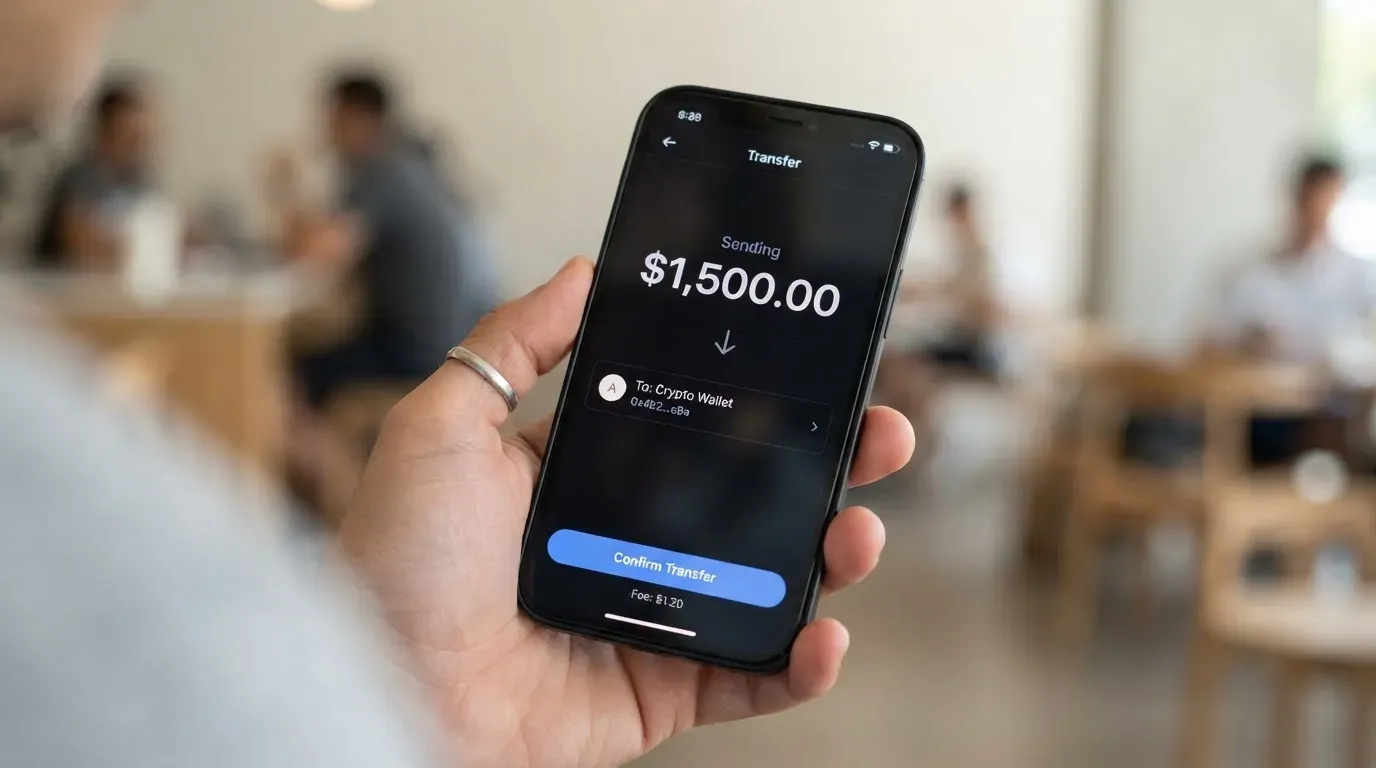
USDC can be deposited on Solana, Ethereum, Arbitrum One, Base, BNB Smart Chain, and Polygon. USDT can be deposited on Arbitrum One, Solana, Ethereum, BNB Smart Chain, and Polygon. On top of that you can fund by debit card and by Apple Pay on iOS. That is a wide set of rails for both major dollar stablecoins, plus two familiar conventional routes for people who do not want to touch a blockchain at all.
The deposit itself carries “no fee (no min. balance)” in the terms. Network gas is charged by the blockchain, not by Exodus, and is small and variable — typically around $0.01. The fees that exist sit on the asset side rather than the deposit side: 0.5% for a stablecoin in a currency that is not the cardholder’s or merchant’s country, free up to $1,200 a month then 0.5% for DeFi and yield tokens, and 0.875% for other cryptocurrencies. The fees for the pay-side deposit options — the debit card and Apple Pay routes — are not stated, so treat that route as one to ask about rather than price in advance.
Two mechanics of the wallet card catch people out.
The balance lives on Solana, and a purchase has to be covered by a single asset. That is the price of the clean fee structure: no automatic piecing a purchase together from three different tokens. If you hold only $4 of USDC and want to spend $12, it does not matter that you also hold $8 of USDT in the same balance.
Depositing on the wrong network is the other one. Blockchain transfers are irreversible, so a deposit sent on a network the card provider does not support, or to an address belonging to a different network, can be lost or need manual support recovery with no guarantee. Read the network list above, and read it again before your first transfer, not after it.
There is also a structural point that trips up the wording “withdraw from your card”. Because the model is self-custody, your funds stay in the linked wallet — there is nothing to withdraw from the card in the ordinary sense. Refunds are credited to the Card Account and may be unavailable for up to five days. If you close the Card Account, you can request a cheque of the Card Account balance, for a fee that is not stated.
Paying with it every day
The shape of daily use is simple. It is a Mastercard, virtual and physical, spending the value in your wallet. Where it gets interesting is at the edges of normal card behaviour, and two of those edges are awkward.
There is no PIN. The card does not currently support a PIN. At terminals that ask for one, you may be able to confirm without it. That is fine for card-present taps and chip, and awkward for anything PIN-gated: deposits, larger cash machines, and some unattended terminals. If your mental image of a debit card includes a four-digit number, this is not that card yet.
Apple Pay is described for adding money, not for paying. The card pages describe Apple Pay as a way to add funds on iOS. Wallets as a payment method for the card itself are not disclosed. So I would not plan around tapping your phone to pay until you have confirmed it yourself in the app.
Everything else is ordinary in the best way. A merchant category code — the four-digit classification assigned to a business when it starts accepting cards — governs what gets through, and some categories are blocked by issuer policy rather than by law. Gambling sits under MCC 7995, and many issuers block it on specific cards, with the list varying by issuer. If you are heading for a bookmaker or a casino, expect a decline and do not assume it is a mistake on your part.
Two other payment realities apply here as they would to any card issued in one country and used in another. Merchants can look up the BIN to see which institution and country issued a card, and may apply extra scrutiny if the issuer country differs from the billing address — that is why a card issued in one country can look “foreign” in another shop. Address Verification Service, which compares the numeric parts of a billing address the buyer typed against issuer records, is mainly offered in the US, Canada, and the UK and is generally unavailable for foreign-issued cards, which can cause declines. And a declined authorisation may leave a hold on funds that can remain for several days, typically up to seven.
Rewards. An official press release says that from 1 July 2026, card holders in Argentina, Brazil, Mexico, Colombia, and Uruguay can pay DGO and SKY+ subscriptions, and that new customers in those countries could get a 25% cashback offer subject to terms. That is a regional, subscription-specific arrangement rather than a general rewards rate, which is not stated. The Metal tier’s 3% on the first $10,000 a year, then 1%, is the general one.
The app itself holds a 4.6 out of 5 on the App Store from 38K ratings, read on 20 October 2026, for iPhone, iPad, and Vision. I did not read the Google Play rating, so I cannot tell you what Android users say.
What can go wrong
This is the section where the card deserves the most of your attention.
The issuer situation. On 1 May 2026, Exodus Movement completed its acquisition of Monavate Holdings (issuer Monavate Ltd, FCA-authorised) and Baanx, with the shares acquired from receivers after a W3C loan default, and $175M announced in November 2025. Q2 2026 results mention a 25% workforce cut. The CEO reportedly said Monavate cannot issue cards for new European clients, in the context of a Bank of Lithuania inspection of Monavate UAB in late 2025. A newer help article says new US card issuance is not open. I want to be precise about the sourcing: the workforce cut and the Bank of Lithuania inspection come from company results and reporting rather than from the card’s own terms; treat the “cannot issue to new European clients” line as reported, not confirmed on an official page I could check. The pattern is what concerns me — a new issuer, a programme manager acquired from receivers, a regulator inspection, a quarter in which a quarter of the workforce went, and an acceptance page saying new US issuance is closed. Programme closures are not hypothetical in this category: Visa terminated its global agreements with FTX on 13 November 2022, and WaveCrest, a Visa card issuer that supplied crypto card brands, was suspended by Visa in Europe in 2018, closing all WaveCrest-issued Visa programmes.
Complaints. On Trustpilot, exodus.com sits at roughly 4 out of 5 from about 4,380 reviews, and the company replies to 93% of negative reviews. I searched for card-specific complaint threads and Reddit results and found none. The negative themes that do appear are about the wallet, not the card: blocked transactions, high fees, and unresponsive support. One review describes a debit card validation failure that was fixed after escalation. That is a fair summary: the card is not the thing people are angry about, and the company is responsive on paper.
Your money’s position. The terms describe self-custody: the card spends value from your own wallet, you set a spending limit, you can freeze the card in the card dashboard, add or remove wallets, and you should report a lost or stolen card immediately. That is the good version. The trade is that key loss, phishing, and clipboard-hijacking malware that swaps an address you copied all become your problem alone — crypto transfers are typically irreversible, and a stolen private key has no built-in recovery, because the network cannot freeze or return funds. Whether the newer Solana-based balance wording on the custody question is identical is not stated. Insurance is not stated either.
Disputes. Purchases are refunded as credit to the Card Account, which may be unavailable for up to five days. Your liability for an unauthorised transaction is limited to the face amount plus fees. Disputes with the programme manager go to arbitration under Delaware law, with a class waiver. Chargeback time frames are not stated. If a dispute ever happens, you are reading your rights in a document written from the issuer’s side, and the class waiver is a real constraint on joining others with the same problem.
Support routes. For Metal and replacement, the terms give [email protected]. For the issuer, Monavate gives [email protected]. There is a toll-free number on the back of the card. Who owns a given question is not defined, and in a stressful moment that ambiguity costs time.
Legal footing, briefly. MiCA is the EU’s markets-in-crypto-assets regulation; under it, e-money tokens may be issued only by a credit institution or an electronic money institution. The card itself is regulated separately as a payment service, which means a crypto card often depends on two licences. EMIs must safeguard customer funds by segregating them in dedicated accounts or insuring them, but such funds are not the same as bank deposits and may not be covered by deposit guarantee schemes. That is a sentence worth reading twice if you are holding an amount you would be uncomfortable leaving outside a bank.
What to take instead
I compared four cards. Only one of the alternatives shares Exodus’s issuer, which is worth noticing on its own.
| Card | Score | Issuer / network | Annual cost | Key fees | Notable limits |
|---|---|---|---|---|---|
| Exodus | 6.8 / 10 | Monavate Ltd (FCA), Mastercard, via Baanx | Free tier $0; Metal $199/year | 1% cross-border on Free; 2% ATM; 0.5% for a non-local-currency stablecoin | 42 supported territories; no PIN; new US issuance not open |
| MetaMask | 7.1 / 10 | Monavate, Mastercard | Virtual free; Metal $199/year | “Minimal fee for each transaction”, amount not stated; no FX fee, Mastercard rate | 45 listed countries; one card per user; US and UK sign-ups temporarily closed |
| KAST | 6.1 / 10 | Visa (Standard, Infinite) | $0 / $1,000 / $10,000 per year across tiers | FX 0.5%–1.75% by country; 0.10 USD under $25; 0.50 USD for a declined transaction | Country list not published; up to 10 cards; 1 USD/month inactivity after 12 months |
| Zeal | 6.1 / 10 | Visa | Not stated — no fee schedule published | No additional FX fee, Visa wholesale rate; Gnosis Pay fees may apply | Spend in 150+ countries; issuance depends on regional availability |
MetaMask scores highest of the four at 7.1 out of 10. It also issues through Monavate, so if the issuer story worries you, it does not solve that — it is the same issuer with a different front end. What it does offer is a genuinely free virtual card, instant on approval, spendable directly from the connected wallet across Linea, Base, Monad, and Solana, with MetaMask naming mUSD, wETH, EURe, GBPe, USDC, and USDT among the tokens. Cashback is paid in mUSD into the Money Account: 1% on Virtual, and on Metal a headline 3% that a footnote limits to the first $10,000 spent and then 1%. Sign-up is open in 45 listed countries and territories — Andorra, Argentina, Brazil, Canada, Mexico, Germany, France, Spain, Uruguay among them — with other regions on a waitlist, and the site is explicit that ineligible regions limit sign-ups rather than spending. Proof of residency is required, citizenship rules are not stated, and US and UK sign-ups are temporarily closed.
KAST is the one to look at if you want the fee schedule published. Stablecoin top-up 0%, USD spending 0%, transaction fee 0%, Apple and Google Pay 0%, and a non-USD FX fee of 0.5%–1.75% depending on your residence country, transaction country, and card programme. It runs Visa Platinum, Infinite metal, and Infinite gold plated tiers, with named cashback tiers of 1.5% on the first $2,000 a month, 2% on the first $10,000, and 3% on the first $40,000. Against that: membership starts at $0 and climbs to $1,000 and $10,000 a year, Standard physical cards carry a $40 delivery charge, there is a $2 extra virtual card in some regions, and a 1 USD a month inactivity fee after twelve months. Its availability rules are unusually explicit — the country list is not published, but it tells you that living in a supported country with only an ID from a restricted region may still fail KYC, that dual citizens with an ID from a supported country may pass, that only the account holder’s own ID is accepted, and that a VPN does not bypass any of it. If you are in an unsupported country, you can create an account, but KYC stays locked.
Zeal is the simplest to try: spend in 150+ countries, a Visa card, virtual for online use, addable to Apple Pay, no additional FX fee with conversion at the Visa wholesale rate, and up to 4% cashback paid in GNO on Gnosis Chain if you hold GNO in the card Safe. Its card programme is live in the EU, UK, Brazil, Colombia, Mexico, Japan, Singapore, the Philippines, Indonesia, and Thailand. The gaps are real: its cost is not stated because no fee schedule is published on its site or App Store, its balances are EUR/USD/GBP accounts on Gnosis Chain and Celo per the docs, and the exact coins are not stated for Zeal itself. Physical cards are not stated either.
My own ordering: if the reason you want a crypto card is that you hold crypto and want to spend it, Exodus on Free and MetaMask Virtual are the two worth real consideration. If your constraint is that you need to know every fee in advance, KAST publishes the most. If your constraint is that you want to spend in as many countries as possible, Zeal states the widest reach.
Who I would recommend it to
I would point this at four kinds of person.
You already keep money in an Exodus wallet, and you spend in dollars or in the local currency of one of the 42 supported territories. You get a free tier that costs nothing, USDT and USDC deposits across a wide set of networks, and the freedom to freeze the card and set a spending limit from the app. This is the card’s actual audience and it serves them well.
You travel or buy in several currencies and pay $199 for Metal. The cross-border fee disappears under fair use, the ATM allowance covers $1,200 a month before the 2% starts, the limits rise, and the cashback is 3% on the first $10,000. Buy the Metal tier for the fees, not for the metal.
You can tolerate a fee that the terms describe rather than a number the website prints. The costs are knowable — 1% cross-border on Free, 2% ATM, 0.5% on a mismatched stablecoin, 0.875% on other tokens, typical gas of about $0.01 — but you have to assemble them yourself from the terms document, and the figures come from a Baanx-era document that may not fully match the newer card.
You accept that your wallet, not a bank, is the account. Self-custody means a lost seed phrase or a swapped address is unrecoverable. If that trade makes you nervous, no card in this category fixes it, and you should be looking at a custodial option with deposit protection instead.
And who I would not point it at: anyone whose country is off the list, anyone whose main problem is that they cannot get a normal bank card and needs one that works without friction everywhere — this is a crypto wallet card, and foreign BINs, absent Address Verification Service, and blocked merchant categories are part of that. Anyone who needs a PIN, uses ATMs as a routine, or wants a fee schedule on a single page. And anyone deciding today without an answer on the issuer, because that is the one question I could not resolve from the card’s own pages.
Frequently asked questions
What is the Exodus Card?
It is a Mastercard debit card that spends value held in your own Exodus wallet rather than a bank account. You get a virtual card and, if you pay for the Metal tier, a physical metal card. The issuer is Monavate Ltd, an FCA-authorised e-money issuer, and the programme manager is Baanx. Nothing on the card is credit; it draws on stored value.
How does the Exodus Card work?
Your balance sits on Solana, and a purchase draws on it in a fixed order: USDT first, then USDC, then XO Cash. A single purchase must be covered by a single asset, so the card will not piece one payment together from several tokens. You can set a spending limit, freeze the card, and add or remove wallets from the card dashboard.
Is Exodus a bank?
No. Exodus is a crypto wallet company, Exodus Movement, and the card is issued by a separate licensed institution, Monavate Ltd, which is an e-money institution rather than a bank. An EMI in the EU can issue e-money, cards, and wallets but cannot lend. Its safeguarded customer funds are not bank deposits and may not sit under a deposit guarantee scheme.
Does the Exodus Card require KYC?
Yes. Identity verification is required for the card, cash deposits, and redeeming points. You need a phone number receiving a code by WhatsApp or SMS, then email verification, then an ID check in the app. Former Spend Card users migrate without re-verification. The card’s pages do not state review times, levels, or rejection reasons.
Is the Exodus Card free?
Partly. The Free tier has a $0 annual subscription. The Metal tier is $199 a year, auto-renews, and can be cancelled within 14 days for a refund, with a $99 replacement fee. If you cannot tell whether your country is supported, check the 42-territory list before anything else.
What does it cost to use the Exodus Card?
On Free, spending outside your country of residence costs 1%, ATM withdrawals cost 2%, a stablecoin in a currency that is not your country’s costs 0.5%, and other tokens such as wrapped Ether cost 0.875%. Purchases in other currencies convert at the card network’s rate, and the programme itself adds no conversion fee. Exact amounts are not stated.
How do I top up the Exodus Card?
USDC can be deposited on Solana, Ethereum, Arbitrum One, Base, BNB Smart Chain, and Polygon; USDT on Arbitrum One, Solana, Ethereum, BNB Smart Chain, and Polygon. You can also fund by debit card or Apple Pay on iOS. The deposit carries no fee, network gas is typically about $0.01, and send only on a network the card supports — transfers are irreversible.
Is the Exodus Card safe to use?
It uses self-custody, so your crypto stays in your wallet and you can freeze the card, set limits, and report it lost immediately. The trade is that key loss, phishing, and clipboard malware are yours alone, with no built-in recovery. Insurance is not stated, and disputes go to arbitration under Delaware law with a class waiver.
Why can’t I get a new Exodus Card?
Two reasons appear in what I could read. A newer help article says new US card issuance is not open. Separately, Exodus acquired Monavate and Baanx on 1 May 2026, Q2 2026 results mention a 25% workforce cut, and the CEO reportedly said Monavate cannot issue cards to new European clients after a Bank of Lithuania inspection in late 2025.
Is the Exodus Card worth it?
On the Free tier, yes, if you already hold USDT or USDC and spend in your own currency — the cost is genuinely zero. Metal at $199 a year is worth it if you travel or use ATMs, since it removes the 1% cross-border fee and covers $1,200 of monthly withdrawals. If you mostly buy subscriptions in several currencies, MetaMask Virtual is the free competitor worth comparing.
Wallet cards – cryptocardbasics
Content created by the «cryptocardbasics» team