
Karma promises cheap self-custody spending. The price list is clear. Almost everything else is not.
 Available in US
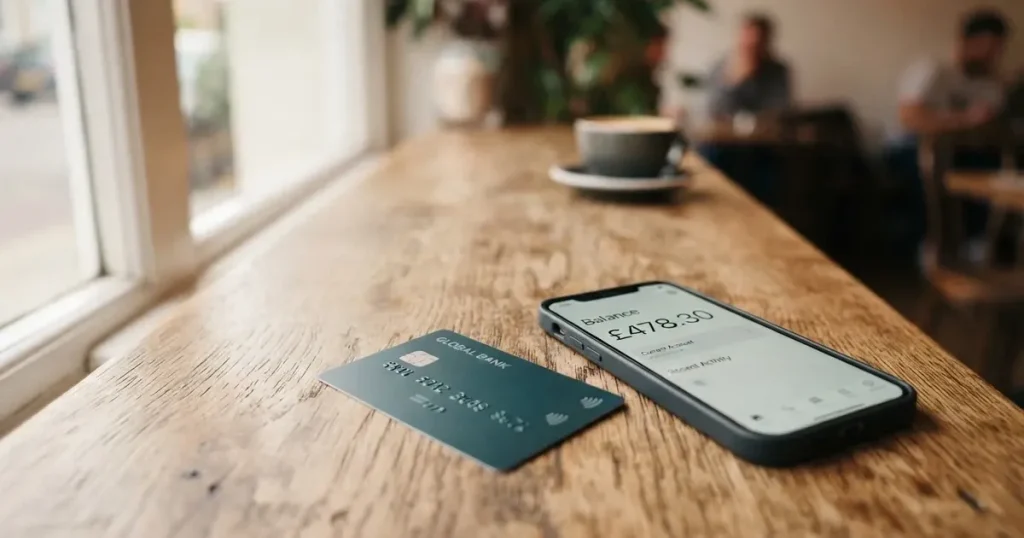
Karma is one of those crypto cards that sits somewhere between the prepaid cards most people recognise and the self-custody wallets that crypto people argue about. On paper it is the better version of that bargain: you keep your own wallet and keys, you load the card with USDC, and you pay a service fee that most competitors would find embarrassing to charge. Visa does the accepting, and a company called Third National issues the plastic. That is the pitch, and for the part of it that involves moving money it is a decent one.
The trouble is that a card is not only about moving money. A card is a thing you use in a shop, at a terminal, in a café queue, on a phone, in an app you have to log into, with your fingers. And that is where the information runs out. Ask Karma’s public pages what the card currency is, whether you get plastic or a virtual number, how long delivery takes, whether Apple Pay works, and you get either nothing or a paragraph in card terms that reads like a credit agreement rather than a description of a prepaid product. I went through all of it and came away with a score of 6.4 out of 10, and that score is mostly a mixture of “genuinely good on fees” and “genuinely blank on the basics”.
Who this card suits, in one line: you already hold crypto, you want to spend it without handing over custody to an exchange, and you are comfortable being an early adopter of a programme that still has some of its publication details unwritten. Who it does not suit: anyone who needs a card that works in a Apple Pay wallet today, or who plans a holiday in one of the seven countries where spending is blocked, or who would rather not hold a stablecoin to buy coffee.
The conditions described below are current as of October 28, 2026.
The score in full
| Criterion | Mark | Why |
|---|---|---|
| Who can get it | 8 / 10 | Issuance is closed to residents or registrants of 17 named countries; other countries are not excluded, and FATF grey-list countries are reviewed case by case. Generous, but with a real exclusion list. |
| Cost | 8 / 10 | No registration, subscription or hidden fees; 0.5% service fee per transaction; 1% FX outside USD plus $0.30; 1% on the way in, 0.5% on the way out. |
| Top-up options | 5 / 10 | Card loads with USDC, with Solana named as a network; USD, EUR and GBP convert through Bridge into crypto; the coin list is not published. |
| Reliability and complaints | 6 / 10 | Cards issued by Third National under a Visa licence, Karma Fintech LTD, registration country not named, programme powered by Rain; no complaints found; App Store 5.0 from 6 ratings; card terms written as a credit line. |
| Everyday use | 3 / 10 | Apple Pay and Google Pay not disclosed (unofficial: not supported); cash advances and balance transfers unavailable; virtual or physical not confirmed. This is the weak spot. |
| Total | 6.4 / 10 | Cheap and self-custodial, but thin on the details you actually use a card for. |
The shape of that table is the whole review. Karma scores well where it can be measured — the price list is public, consistent and, for a crypto card, genuinely competitive — and poorly where it cannot. The everyday-use line is three out of ten because the things you would need to pay for a meal with a phone are not confirmed, and because the card’s own terms do not clearly describe what you are holding when the money is loaded.
Will they give you the card?
Yes, for most of the world — but there is a list, and it is longer than you might expect from a company that markets itself as globally available.
Issuance is blocked for residents or registrants of Belarus, mainland China, Cuba, India, Iran, Iraq, Israel, Myanmar, Nepal, Nicaragua, North Korea, Russia, Syria, Turkey, Ukraine, Venezuela and Vietnam. Read that phrasing carefully, because it matters: the rule is residence or registration, not citizenship. If you moved from one of those countries to, say, Portugal two years ago and now hold a Portuguese address, the block is written against where you are, not where you were born. If you still register in a blocked country, it applies.
That excludes Russian and Belarusian residents outright, and it is worth sitting with what that does and does not tell you. It does not tell you anything about how the rule is enforced or what happens to an account held by someone who moves; it only tells you what the published terms say.
Countries on the FATF grey list are not named on the page I read, but the terms say they need case-by-case approval. That is a slower path, not necessarily a closed one.
Spending — as distinct from holding the card — is blocked in Cuba, Iran, North Korea, Russia, Syria, Ukraine and Venezuela. Seven countries. If you live in a permitted country but travel through or spend in one of those, the card will not work, and no amount of app troubleshooting will change that.
The rule on the company side is also worth reading as a person rather than a lawyer: the card terms say the user must confirm that they are not a US citizen and are not sanctioned. That is the question the issuer will be asking, and it is asked at the point of application rather than discovered later.
What is not stated anywhere on the public pages is the KYC process itself. There is no published tier structure, no document list, no statement of how long review takes. If you need to know before you start, you will have to ask support — and support channels and hours are also not published, beyond an X account at @KarmaWallet.
How to get it
The honest answer is that the sign-up flow is not documented, so here is what is known.
The card is a Visa. The card terms put it plainly: cards are issued by Third National pursuant to a licence from Visa. The App Store listing says a Visa card is accepted at 80M+ merchants, which is the network’s own claim rather than something Karma measures. Whether you receive a virtual card, a physical card, or both is not stated. Neither is the card currency.
On identity checks: the official position, from the card terms, is that there is no KYC process — and in the same breath that you must confirm you are not a US citizen and not sanctioned. That is a thin answer to a reasonable question.
There is a third-party page, unofficial and undated, that describes something called “ID Verification (Lv 3)” for a Karma Card: email, phone and an identity document, with no proof of address and no selfie. It is not confirmed by Karma. The page covers “Karma Card by Karma Wallet”, Visa, Solana and SEPA focus, and appears to describe the same product — but appears is not confirms, and I would not build a decision on it.
On delivery, the card terms mention that physical or virtual cards may be limited, and that replacements can be requested through the account, possibly with a new number. No countries, no delivery time, no cost. If you need a card that arrives somewhere specific, that is a question to ask before you rely on it.
What it really costs
This is the section where Karma is strongest, and I want to give it the credit it deserves before I list everything that is missing.
There is no signup fee, no monthly fee, no subscription, and Karma says explicitly that there are no subscriptions. What there is instead is a running cost per transaction, and it is published in enough detail to do arithmetic on.
| Fee or limit | What the card says |
|---|---|
| Signup fee | None stated — “No subscriptions” |
| Monthly fee | None stated |
| Card service fee | 0.5% per card transaction |
| FX fee | 1% on non-USD, charged by Visa with no Karma markup |
| International fee | $0.30 flat on non-USD |
| Fiat on-ramp | 1%, “additional fees may apply” |
| Off-ramp | 0.5% |
| Swap | 0.5% |
| Cash advance / balance transfer | Not available |
| Spending limits | Karma sets the limit; the issuer may add per-card or total limits; changeable at any time, including to $0; no numbers published |
| ATM | Not stated; cash advances not available |
Two details in that table matter more than the rest. The first is that the FX fee is charged by Visa, not added by Karma — 1% currently, up to 3% per the card terms, with no Karma markup on top. That is unusually clean, and it means the worst case is stated rather than hidden. The second is that the limit structure is not a number but a mechanism: Karma sets a limit, the issuer can add its own, and you can dial yours to zero at any time. That is a sensible design for a self-custody card, but it is not the same as knowing your card will work for a $900 purchase abroad.
The App Store adds one more thing: Karma covers all on-chain transaction costs for USDC transfers on Solana, and staking $KARMA gives fee discounts.
Now three everyday payments, with the fees that actually apply, using only the published numbers.
A $20 lunch in your own city, in your local currency, card balance in the same currency. Service fee 0.5% of $20 = $0.10. No FX fee, because the card terms say foreign-currency transactions are converted to US dollars by the network; if nothing is converted, no conversion fee. Total: 20.10.
A €40 dinner abroad, card loaded in USDC. Service fee 0.5% of €40 = €0.20. The transaction is foreign-currency, so the network converts it to US dollars; FX fee 1% plus a $0.30 international fee apply. You also cross the 0.5% swap if the balance has to move from USDC into the card’s spending currency. Total: €40 plus roughly 1.5% in fees plus $0.30 — the swap step is where the cost gets fuzzy, because what the card converts depends on what it is holding.
A $45 subscription paid from a card funded by a bank transfer in EUR. You have already paid something to get the money in: 1% on-ramp, or $1.45 for a SEPA transfer, or $0.95 for ACH, and EUR conversion at the mid-market rate plus 0.50%. Then $0.225 service fee on the purchase. If the subscription renews monthly in USD and your balance is not USD, the FX line applies every month, not once.
That third example is the one to think hardest about. Subscription in a currency you do not hold is where a 1% FX fee plus $0.30 becomes a monthly habit, not a one-off.
There is also a token-tier angle worth knowing about, because it changes the service fee if you happen to hold $KARMA. Holding $10+ gives a 10% rebate on swap fees and the full card service fee; $100+ gives 20% and full; $500+ gives 35% and full; $2,500+ gives 50% and half off; $5,000+ gives 70% and half off; $10,000+ gives 90% and the fee is free. Note what this is: a discount on holding the company’s own token, not a cheaper card for everyone. There are no card-product tiers — no metal, no premium — stated anywhere.
How to top it up
Two routes, and one warning about both.
The core model: Karma is a non-custodial wallet, and money you receive in USD, EUR or GBP into your account is converted to crypto by Bridge and deposited to that wallet. The card is described as loaded with USDC, and the App Store references USDC on Solana. Beyond that the coin list is not published, which is the single biggest practical gap in this section — you cannot plan around an asset you have not been told about.
The costs on the way in are specific:
- Fiat on-ramp fee 1%, with the note that additional fees may apply.
- SEPA transfer $1.45.
- ACH transfer $0.95.
- EUR, GBP and MXN conversion at the mid-market rate plus 0.50%.
- An extra fee on “high-risk payments”, capped at 5% of the deposit. What makes a payment high-risk is not defined.
- No monthly or signup fees. Karma sponsors network gas on default routes.
- Minimum top-up: not stated.
On the way out: withdrawals convert back to fiat and settle to your bank account, with an off-ramp fee of 0.5%. The App Store says you can withdraw to a bank or an external wallet “at any time”.
The warning is about network choice, and it is the one that costs people money. Blockchain transfers are irreversible. If you send on a network the card provider does not support, or to an address belonging to a different network, the funds can be lost entirely or need manual support recovery with no guarantee. USDC on Solana is the network Karma references — but USDC exists on dozens of chains, so “USDC” is not enough information to send on. Check the network in the app, every time.
Paying with it every day
Here the record thins out, and this is where I would slow down.
Apple Pay and Google Pay are not disclosed. A third-party page, unofficial and undated, says they are not supported. If mobile wallets matter to you — and for everyday paying they usually do — treat this as unresolved rather than as a no, and ask before you plan around it. If the unofficial page is right, you are signing a number at a terminal for every coffee.
Cash advances and balance transfers are not available, which in practice means no ATM withdrawal and no transferring a balance to another card. That is a bigger limitation than it first sounds, because an ATM is often the emergency exit when a card is declined.
Rewards: the App Store version 1.1 notes describe reward tiers with cashback on fees, “Karma Points” earned on card spend, and pending cashback tracking. The rates are not stated. Read that as a system that exists and a number you do not have.
The app itself is thin evidence either way. On the App Store it showed 5.0 out of 5 from 6 ratings when I looked, requires iOS 15.1+, and the latest version was 2.0.2. A Google Play listing exists but its rating was not readable. Six ratings is not a user base.
What the card can be used for is spelled out in the prohibited list, and the list is long: digital currency purchases (except through Karma), cannabis and CBD, the dark web, unlicensed pharmacies, firearms, escort services, payday lending, multi-level marketing and Ponzi schemes, counterfeit goods, and “illegal gambling operations or unregulated betting platforms”. Regulated gambling and fantasy sports are handled differently, and crypto platforms, exchanges and money-service businesses get enhanced review — which means a payment to another exchange can be declined even though buying crypto through Karma is allowed. If you move money between venues for a living, that line matters.
If a payment goes wrong, the route is: ask the merchant first, then file a chargeback in your Karma account no more than 60 days after the charge posts. Won chargebacks are credited to a current or future statement. Unresolved ones can lead to fees, lower limits or suspension. That is a reasonable process. It is also the only dispute path this card has, because the terms do not describe it as a credit card with the statutory protections a US credit card holder would have.
What can go wrong
The credit-line problem. This is the thing I keep coming back to. The card terms are written like a credit agreement: 0% APR, late payment up to $40, returned payment up to $29, a repayment obligation that survives closure. None of that fits a product described elsewhere as “loaded with USDC”. If you are holding a stablecoin balance, none of those clauses should be able to reach you — but the document says they might. Either the terms are copy-pasted from a template, or there is a credit line somewhere here that the marketing does not mention. I would want that answered in writing before I loaded anything sizeable.
Nobody can tell me where the company is registered. Karma Fintech LTD is the App Store seller and “Karma Pay” is the developer name. It says it is not a bank, an exchange or a custodian. The programme is powered by Rain. Cards are issued by Third National under a Visa licence. The registration country is not stated. For a business that asks you to confirm you are not a US citizen, its own jurisdictional transparency is a fair question.
No insurance, deliberately. Karma says you control your wallet and your keys and that it cannot freeze, seize or move your funds. It also says there is no insurance and instructs you not to expect FDIC cover. That is the honest version of self-custody: the upside is that no intermediary can pull your money, and the downside is that nobody compensates you when something goes wrong. Passkeys and biometrics guard sensitive actions, higher-risk actions get an extra confirmation, you can freeze and unfreeze the card in-app (subject to the issuer), and velocity limits apply. Audits are described only as conducted “under NDA”, which is a phrase that means you will not see them.
You hold the key, you hold the risk. Self-custody means a seed phrase — typically 12 to 24 words — that anyone who obtains can use to restore the wallet and spend the balance. Transfers are irreversible, and a stolen key has no recovery mechanism, because the network cannot freeze or return funds. Custodial platforms have a record of this going badly: Mt. Gox around US$350 million reported stolen across 2011–2014, Coincheck around US$400 million in 2018, and Ronin Network US$625 million in 2022. Karma’s argument is that it removes that counterparty risk. The other side of the same coin is phishing and clipboard-hijacking malware that swaps a copied address.
Programmes do end. In November 2022 Visa terminated its global agreements with FTX and the US debit card programme was wound down. In 2018 Visa suspended WaveCrest in Europe, closing every WaveCrest-issued Visa programme. The pattern is ordinary: a notice period, spending and loading stop, and users are asked to withdraw remaining balances. The card terms also say the issuer may suspend or cancel access at any time.
Nothing is blocked in your favour, only against. A card issued in one country can look foreign to a shop in another: merchants look up the issuer identification number at the start of the card number and may apply extra scrutiny when the issuer country differs from your billing address. Address verification, which compares the numeric parts of the billing address against issuer records, is mainly offered in the US, Canada and the UK and is generally unavailable for foreign-issued cards — a common cause of declines. Declined authorisations can also leave a hold on funds for up to several days. And merchants can decline prepaid or foreign-issued cards by policy, not by law. So the same card that is cheap everywhere in theory can be declined at the one shop where you needed it.
On the specific case of stablecoins. Tether’s USDT and Circle’s USDC are the two tokens holding about 90% of stablecoin market capitalisation, per the BIS in July 2025. Circle says USDC is redeemable 1:1 for USD and fully backed by cash and equivalents, mostly in an SEC-registered government money market fund, with monthly reserve attestations; it lists USDC as natively supported on 38 networks as of 16 September 2026. But stablecoins can depeg — TerraUSD collapsed in May 2022, and USDC briefly lost its peg in March 2023 — and Tether says it disables tokens in wallets on the OFAC sanctions list and has frozen funds tied to illicit activity. The stablecoin you hold is not censorship-proof and not risk-free.
Support you cannot find. Channels and hours are not stated on the site or in the App Store. An X account exists. If your card is declined in a country where you cannot reach anyone, that is the situation you will be in.
What I found about complaints: nothing. One search for Karma Pay card complaints turned up only reviews of other products. There is no Karma-specific Reddit presence, no Trustpilot page, no news coverage of problems. That is genuinely good news and it is also thin evidence — a card with six App Store ratings does not generate complaints. Absence of complaints here means absence of users at least as much as absence of trouble.
What to take instead
If the fee structure is what drew you, three alternatives are worth pricing. I am not going to rank them above Karma, because the scoring criteria differ and you may weight them differently — but you should look at all three before settling.
| Karma | MetaMask | KAST | Zeal | |
|---|---|---|---|---|
| Score here | 6.4 / 10 | 7.1 / 10 | 6.1 / 10 | 6.1 / 10 |
| Network | Visa | Mastercard | Visa | Visa |
| Access | 17 countries excluded for issuance | 45 listed countries/territories | Residence list shown at KYC, not published | Spend in 150+ countries, issuance by eligibility |
| Card cost | No signup or monthly fee | Virtual free; Metal $199/year | Standard 0 USD; Premium 1,000 USD/year; Private 10,000 USD/year | Not published |
| Transaction fee | 0.5% | “Minimal”, amount not stated; no MetaMask fee | 0% on USD card spend | No extra FX fee; Visa wholesale rate |
| FX | 1% plus $0.30 on non-USD | No FX fee, Mastercard rate | 0.5%–1.75% by country; $0.10 under 25 USD | None added by Zeal |
| Cashback | Karma Points, rates not stated | 1% virtual, 3% metal to the first $10,000 then 1% | 1.5% / 2% / 3% by tier, capped monthly | Up to 4% in GNO, must be held in the card Safe |
| Mobile wallets | Not stated; unofficial: unsupported | Not stated | Apple and Google Pay at 0% | Virtual card addable to Apple Pay |
MetaMask is the strongest of the three on this card’s own terms, and it earns it partly by publishing more. Sign-up is open in 45 listed countries and territories including Brazil, Canada, Mexico, Germany, France and Spain, with other regions on a waitlist; proof of residency is required, and ineligible regions limit sign-up rather than spending — a different and arguably fairer design from Karma’s exclusion list. You get a virtual card instantly and can pre-order metal in the app afterwards, one card per user, issued by Monovate. Virtual is free with no annual or maintenance fee; metal is $199 a year. It spends directly from a connected wallet across Linea, Base, Monad and Solana, with mUSD, wETH, EURe, GBPe, USDC and USDT named. Cashback is 1% on virtual and 3% on metal to the first $10,000 spent, then 1%. US and UK sign-ups are temporarily closed per its own FAQ.
KAST is the fee-floor option, and the price ladder is steep enough to matter. Standard is free, Premium is 1,000 USD a year and Private is 10,000 USD, billed annually upfront with no monthly option; Standard physical is a 0 USD card fee plus 40 USD delivery, and there is a 1 USD monthly inactivity fee after 12 months. In exchange, stablecoin top-up is 0%, USD card spend and transaction fees are 0%, Apple and Google Pay are 0%, and cashback runs 1.5%, 2% and 3% by tier with monthly caps. It supports virtual and physical, up to ten cards, across Visa Platinum, Infinite metal and Infinite gold, plus themed designs. What gives me pause is availability: the country list is not published, you only find out at KYC, and holding an ID from a restricted region can disqualify you even if you live in a supported country — VPN does not bypass it.
Zeal is the quiet one. You can spend in 150+ countries, with the card programme live in the EU, UK, Brazil, Colombia, Mexico, Japan, Singapore, the Philippines, Indonesia and Thailand. It charges no additional FX fee and converts at Visa’s wholesale rate. You get a virtual card for online use that can be added to Apple Pay, with EUR, USD and GBP accounts on Gnosis Chain and Celo. Cashback is up to 4% in GNO, payable only if you hold GNO in the card Safe, and rates can change; the app also advertises up to 5% variable APY on EUR and USD balances. What it does not publish is any fee schedule at all, on zeal.app or the App Store, which is a real drawback when you are trying to work out what a purchase costs.
Against all three, Karma’s honest advantages are the lowest stated running cost for small everyday spend and the clearest custody story. Its disadvantage is that it tells you the least about what you actually receive.
Who I would recommend it to
I would recommend Karma to someone in this position: you already hold USDC, you are settled in a country that is not on the seventeen, you do not need Apple Pay, you want to keep your keys, and you are the kind of person who is happy to ask support a question before committing money. For that person, 0.5% a transaction with a 1% FX line and no monthly fee is a good price, and self-custody is a real position rather than a marketing phrase.
I would not recommend it to someone whose first question is whether the card will work in their wallet. That question has no published answer, and the unofficial answer is no. I would not recommend it to anyone planning a trip to Russia, Ukraine, Belarus, Cuba, Iran, Syria, North Korea or Venezuela, or to anyone who needs an ATM. And I would hold off if you are the kind of customer who reads a terms page and expects the terms page to describe the product.
Two things would move my score materially, and both are answerable by a single email. The first is a plain description of what the card terms mean when the balance is USDC — is that 0% APR credit language a template error, or is there a line of credit? The second is a yes or no on Apple Pay and Google Pay, plus virtual versus plastic and delivery. Get those in writing and the card becomes a 7 or so overnight; leave them unanswered and the questions follow you for as long as you hold it.
One last thing, and it is not specific to this card. If you spend crypto through a card, each payment funded from crypto may be treated as a disposal for tax purposes, with the gain measured in your local currency at the fair market value on the date of the transaction. The IRS treats digital assets as property. I am not qualified to advise you on what that means for you, and I am not going to guess — but if you use any of these cards regularly, that is a conversation to have with someone who is.
Frequently asked questions
What is the Karma card?
Karma is a Visa payment card connected to a self-custodial crypto wallet. You hold your own keys, load the card with USDC, and spend from that balance. Visa’s network handles acceptance and Third National issues the card under a Visa licence, while Karma runs the programme and is the company you deal with. It is not a bank account and it is not an exchange.
Is Karma a bank?
No. Karma says plainly that it is not a bank, exchange or custodian. The App Store seller is Karma Fintech LTD, the programme is powered by Rain, and cards are issued by Third National. The company’s registration country is not stated on the pages I read, and it says it provides no FDIC insurance — so treat the money as uninsured, because it tells you to.
Who owns Karma?
Karma Fintech LTD, trading as Karma Pay, according to the App Store listing. The $KARMA token is live on Robinhood Chain, Karma v1 holders can migrate to v2, and the Karma ICM Association, a Swiss non-profit, oversees the protocol and treasury. I found no licence news and no issuer-change news.
Does the Karma card require KYC?
The official card terms say there is no KYC process, and also require you to confirm you are not a US citizen and are not sanctioned. A third-party, undated page describes an identity check needing email, phone and an ID document, with no proof of address or selfie. That is unofficial and unconfirmed by Karma, so treat it as a hint rather than an answer.
What are the fees on the Karma card?
There is no signup fee, no monthly fee and no subscription. The service fee is 0.5% per card transaction. On non-USD spending you pay 1% FX charged by Visa with no Karma markup, plus a $0.30 international fee. Fiat on-ramp is 1%, off-ramp 0.5%, swap 0.5%. Cash advances are not available.
Can I use the card in my country?
Issuance is closed to residents or registrants of 17 countries: Belarus, mainland China, Cuba, India, Iran, Iraq, Israel, Myanmar, Nepal, Nicaragua, North Korea, Russia, Syria, Turkey, Ukraine, Venezuela and Vietnam. Spending is blocked in Cuba, Iran, North Korea, Russia, Syria, Ukraine and Venezuela. Other countries are not excluded, and FATF grey-list countries are reviewed case by case.
How do I top up the card?
You can send USD, EUR or GBP into your account, and Bridge converts it to crypto that is deposited to your wallet; the card is described as loaded with USDC, with Solana referenced. A SEPA transfer costs $1.45 and ACH $0.95, the on-ramp fee is 1%, and EUR, GBP and MXN convert at the mid-market rate plus 0.50%. Minimum top-up is not published.
Can I add it to Apple Wallet?
Not answered on Karma’s public pages. An unofficial third-party page, with no date shown, says Apple Pay and Google Pay are not supported. Since your card ends up in a wallet at a counter more often than people expect, I would ask support directly before planning a week around it — and treat the unofficial answer as the likely one.
Is the card safe?
The security model is genuinely strong in one direction: non-custodial, passkeys and biometrics for sensitive actions, extra confirmation for higher-risk actions, in-app freeze and unfreeze subject to the issuer, and velocity limits. The other direction is your responsibility — a seed phrase cannot be recovered if lost or stolen, transfers are irreversible, and there is no insurance or FDIC cover.
Is the card worth it?
For small, frequent spending funded from stablecoins you already hold, the 0.5% fee and absence of a monthly charge are competitive, and keeping your own keys is a real advantage. Against that, mobile wallets are unconfirmed, there are no published spending-limit numbers, no delivery details, and card terms written as a credit line that does not match a USDC-loaded product. I score it 6.4 out of 10 and would revisit it after those gaps are answered.
Wallet cards – cryptocardbasics
Content created by the «cryptocardbasics» team