
KeyOne card review: a free virtual Visa paid from a self-custody wallet
 Available in US
KeyOne is a virtual Visa card you fund from a self-custody crypto wallet. The card itself is issued by Wirex under Visa’s licence, while KeyOne Solution Ltd. runs the app and the wallet interface. On the Free plan there is no issuance fee, no monthly fee and a 0% fee for spending in euros, so it reads, on paper, like one of the cheaper crypto cards on the market. The catch is that “cheaper” here is relative to a category in which most products charge several percent per transaction. Whether KeyOne is genuinely good value depends on what you want from a card and how much the limits and the missing pieces (no physical card, no Google Pay, no cashback) bother you.
This review is based on KeyOne’s own pages, the cardholder agreement and the terms, checked on 20 October 2026. I have not applied for or used the card. Where the public pages are silent on a detail, I say so rather than guess.
Conditions are current as of October 28, 2026.
Verdict
KeyOne earns 6.8 out of 10 in my scoring, with the breakdown shown below. It scores well on cost and the breadth of supported countries, and reasonably on top-up flexibility and reliability (no public complaint trail), but it loses marks on everyday use: it is virtual-only, Google Pay is not confirmed, and there is no cashback or rewards programme of any kind.
| Criterion | Mark | Why it lands there |
|---|---|---|
| Who can get it | 7 / 10 | Residents of 70 listed countries across Europe, Asia, the UAE, Africa, Latin America and Australia |
| Cost | 8 / 10 | Free plan: zero issuance and monthly fee, 0% in euros, conversion up to 1%, crypto top-up 0.8% plus network fee |
| Top-up options | 7 / 10 | USDC and USDT (network not named), plus SEPA, ACH and Visa/Mastercard top-ups; crypto withdrawal is on Base only |
| Reliability and complaints | 7 / 10 | Issued by Wirex (Visa); KeyOne Solution Ltd. is the technology interface, not a bank; no complaints found and no App Store rating yet |
| Everyday use | 4 / 10 | Virtual Visa only, Apple Pay confirmed, Google Pay unconfirmed, ATM access unstated |
| Total | 6.8 / 10 |
The card suits people who want a low-fee euro Visa they can load from a self-custody wallet and use for everyday online and in-store spending within the published limits. It is well matched to residents of countries where getting a regular bank card is hard, including Georgia, Serbia, Kazakhstan and a long list of other European, Asian and Latin American jurisdictions, who want a free card. It is less suitable for someone who needs a physical card, a cashback programme, ATM access, or a card that clearly states which networks and merchants are blocked.
Will they give you the card
KeyOne is residence-based, not nationality-based. The home page lists 70 countries whose residents can apply, and the page on eligibility says that for any country not on the list you cannot yet apply for a KeyOne card. The list covers:
- Europe: including Georgia, Moldova, Ukraine, Serbia, Azerbaijan, and most EU/EEA states
- Asia: including Kazakhstan, Uzbekistan, Japan and Thailand
- The Gulf: the UAE and Bahrain
- Africa: Nigeria, Ghana, Kenya, South Africa and Uganda
- Latin America: Mexico, Brazil, Argentina and others
- Australia
Russia and Belarus are not on the list. The card’s pages do not publish a separate exclusion list for citizens of unlisted countries, so a Russian or Belarusian citizen resident in, say, Georgia would need to apply from their country of residence and let KeyOne’s own checks decide.
Because the card uses a Visa-issued product under Wirex’s permissions, you should expect the partner’s own compliance checks to be applied on top of KeyOne’s. In practice that means individual limits can be lower than the published maximums, as the terms note.
The card has a balance in euros and fees are quoted in euros, so it is built for euro-zone spending even though residents outside the euro area can also use it.
How to get it
The sign-up is in the KeyOne app. The steps the company lists are:
- Check your country is on the supported list
- Submit a government-issued ID plus a selfie
- Provide proof of address if asked
- Receive the card in the app
Accepted IDs are a passport, an ID card, a driving licence or a residence permit, with the exact types accepted depending on the issuing country. The ID must show your name and date of birth, both of which have to match the application, and the photo has to match the selfie. The validity date must be visible and in the future. Proof of address is requested only after the ID check, and your eligibility is decided by the residence that document shows. The minimum age is 18.
KeyOne does not publish processing times; the help text says they “may vary” and that support can check the status. There is no public mention of a “tier 1 / tier 2” KYC structure, just the two steps above.
The card is virtual only. There is no physical card on offer, and the home page does not mention one in any plan. After approval, the card number, expiry and CVV appear inside the app, and you can add it to Apple Pay from there. Wirex, as the issuer, sets the actual card product.
Fees and what a KeyOne payment actually costs
KeyOne runs two plans. The headline plan is Free, with a paid Premium tier on top.

Free plan (EUR 0)
- Card issuance: free
- Monthly service: free
- Card payments in euros: 0%
- Currency conversion: up to 1%
- Crypto top-up (USDC/USDT): 0.8% plus the network fee
- SEPA or ACH top-up in: 0.8%
- Top-up from another Visa/Mastercard: about 4.5%
- In-app exchange: 0.3% on the first EUR 1,000 a month, then 1.25%
- Cards: one virtual card, no extra cards
- Card spend cap: EUR 20,000 per card per month
Premium plan (EUR 149 per year)
- Paid once for 12 months from the date of purchase; renewing early adds 12 months; non-refundable except where local law requires
- Cards: three virtual cards included, extras EUR 10 each (extra cards are not available on Free)
- Card spend cap: EUR 30,000 per card per month
- Crypto top-up: 0.33%
- SEPA or ACH top-up in: 0.3%
- In-app exchange: 0.3% on the first EUR 2,000 a month, then 1.25%
- There is no metal card
| Item | Free | Premium |
|---|---|---|
| Issuance | EUR 0 | EUR 0 (one of three included) |
| Monthly fee | EUR 0 | EUR 149 / year (one-time) |
| Payments in balance currency (EUR) | 0% | 0% |
| Currency conversion | up to 1% | up to 1% |
| Crypto top-up (USDC/USDT) | 0.8% + network fee | 0.33% |
| SEPA / ACH in | 0.8% | 0.3% |
| Visa / Mastercard top-up | ~4.5% | ~4.5% |
| In-app exchange | 0.3% on first EUR 1,000/mo, then 1.25% | 0.3% on first EUR 2,000/mo, then 1.25% |
| Cards included | 1 virtual | 3 virtual |
| Extra card | not available | EUR 10 each |
| Monthly card spend | EUR 20,000 / card | EUR 30,000 / card |
| Single transaction | EUR 20,000 | EUR 30,000 |
| SEPA in / out | EUR 20,000 / month | EUR 20,000 / month |
Three everyday scenarios make the fee structure concrete:
- A EUR 50 coffee paid in euros from your EUR balance: 0% fee on both plans.
- A EUR 50 dinner paid in US dollars to a US-based merchant: up to 1% conversion fee, so up to EUR 0.50. The actual rate depends on Wirex’s spread at the time.
- A EUR 100 top-up from USDC on Ethereum at a moment when the network fee is, say, USD 2: you pay EUR 0.80 plus the USD 2 network fee on Free, or EUR 0.33 plus the USD 2 on Premium. The network fee is set by the blockchain, not by KeyOne, and it can spike.
KeyOne does not publish some fees, including ATM withdrawal charges. There is no published inactivity fee, over-limit fee, or foreign-exchange margin beyond the “up to 1%” the cardholder agreement mentions. This silence does not mean these fees are zero, only that KeyOne has not disclosed them.
Merchant refunds are credited back to your KeyOne balance (per the cardholder agreement, s.7), and they may arrive in a different currency than the original charge.
Top up
The card accepts four kinds of top-up, and the cost depends on which one you pick:
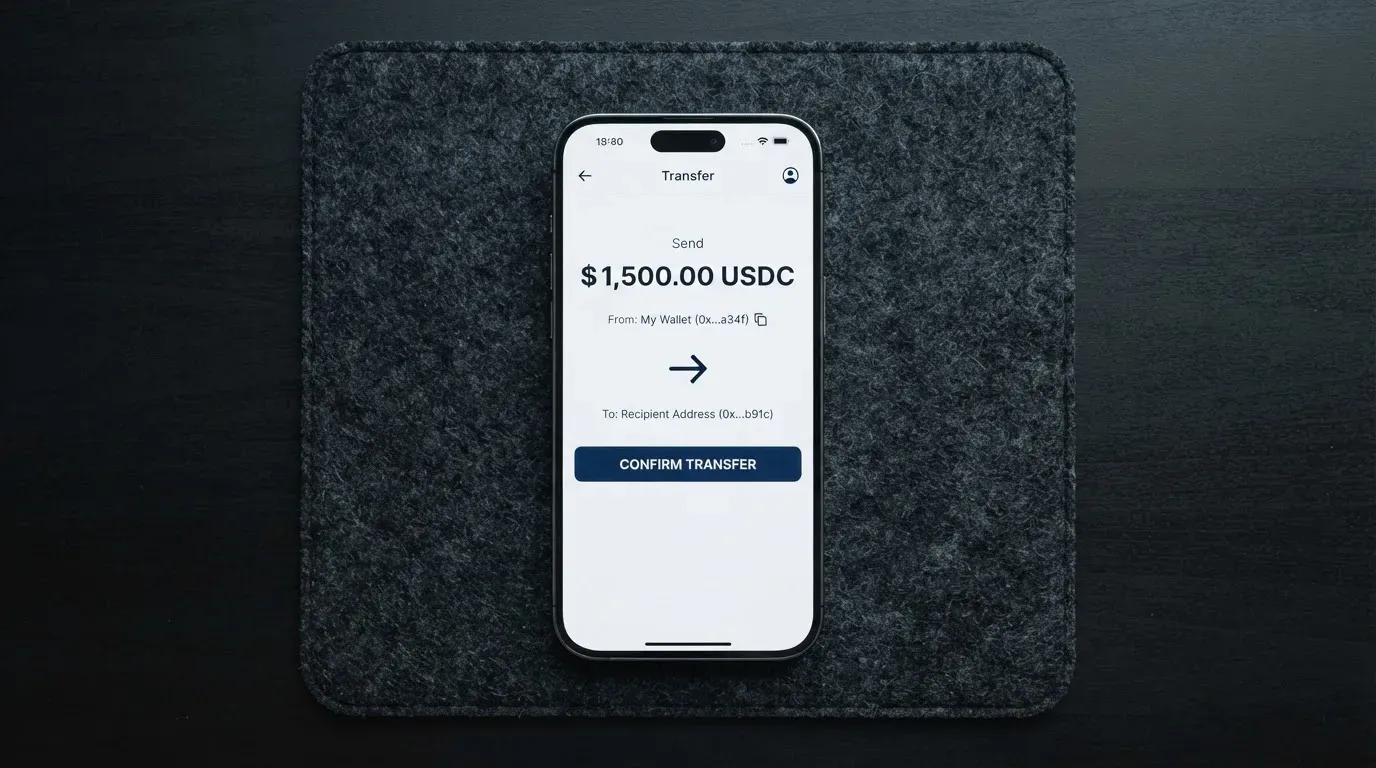
- USDC or USDT (the networks KeyOne accepts for this are not named in the public pages): 0.8% plus the network fee on Free, 0.33% on Premium
- SEPA bank transfer (most EU countries and the UK): 0.8% on Free, 0.3% on Premium
- ACH bank transfer in USD (UK only): 0.8% on Free, 0.3% on Premium
- Top-up from another Visa or Mastercard card: about 4.5%
For GBP transfers KeyOne also supports Faster Payments, again UK-only.
There is no published minimum top-up. SEPA in and out are both capped at EUR 20,000 per month.
Crypto withdrawal is on the Base network only. KeyOne does not charge a withdrawal fee, but you still pay the Base network fee. If you need to send your crypto to a different network, the app will not let you; you would have to move it elsewhere on Base first.
A practical note on funding with stablecoins: USDC and USDT are issued on many blockchains, and KeyOne does not name the network it expects. Sending the same coin on the wrong network is one of the most common ways people lose funds, because the transfer is irreversible and the receiving side may not be able to recover it. Before you send a top-up, confirm the network the app is asking for, and double-check that the receiving address matches it. KeyOne’s pages do not describe a recovery process for misrouted deposits.
You can close the card in the app at any time without touching the balance (s.8 of the cardholder agreement), and the account can be deleted from Profile > Support or by email. After you request deletion, the card and accounts are closed with Wirex within 30 days, and KeyOne keeps KYC and transaction records for five years. You have to withdraw any remaining balance first.
Paying with it every day
KeyOne is a virtual Visa, so it works for online checkout, in-store contactless via Apple Pay, and any other place where you can key in card details or pay with a phone wallet. Apple Pay is supported and the home page says you can add the card “in one tap”. Google Pay is not mentioned in the public pages. Whether it is in the pipeline is not stated.
The cardholder agreement says “some countries, merchant categories and transactions are restricted” but does not publish the list. In practice that means the published limits and the issuer’s own compliance rules decide what you can and cannot do, and you only find out at the checkout.
There is no cashback or rewards programme of any kind. The home page, the cardholder agreement and the terms were checked for the words “cashback”, “rewards” and “bonus” and none surfaced a concrete benefit.
The app is “KeyOne: Crypto Card & Wallet” on iOS, requiring iOS 17 or later, version 1.0.10 at the time of writing, with language support for English, Russian and Serbian. The App Store (Ireland) has not received enough ratings to display a score. The Android listing on Google Play exists (com.keyonesolution.keyone) but its rating was not retrieved for this review. A web app is also available at app.keyonepay.com.
Online payments are protected by 3-D Secure, which means you confirm each transaction in the KeyOne app. A compromised card can be blocked inside the app; the issuer can also suspend or close a card for fraud or because the card is being used from an unsupported country.
For disputes, the cardholder agreement (s.7) says you should contact support, which will help you file a dispute with the issuer. The agreement does not set time limits for this and does not use the word “chargeback”. Blockchain transactions are, by design, irreversible, so once a top-up has been sent from your wallet it cannot be pulled back.
What can go wrong
KeyOne’s own safety story is built around the self-custody wallet on the device. Private keys are created and stored on your phone through an embedded wallet provider, and KeyOne states that the company cannot move your crypto without your signature. That is the upside of self-custody. The downside is the same: if you lose the device, the PIN or the recovery phrase, the funds are gone. KeyOne’s home page is direct about this.
The company, KEYONE SOLUTION LTD, is incorporated in Saint Christopher and Nevis (company number C 63589) and explicitly says it is not a bank. Card issuance and the payment rails are handled by Wirex under its own Visa permissions; KeyOne describes itself as the technology interface only. The cardholder agreement and the terms were both last updated on 12 October 2026, and the governing law of the terms is Saint Christopher and Nevis. KeyOne does not list any banking, e-money or virtual-asset licences on its public pages. That is a notable gap for a product that handles both card payments and crypto balances, and it is worth weighing if regulator standing matters to you.
Because KeyOne Solution Ltd. is not a bank and is not described as an e-money institution, your crypto balance is not covered by any deposit guarantee or investor compensation scheme. Card balances on the Wirex side sit behind Wirex’s own safeguarding, but that is Wirex’s protection, not KeyOne’s.
No licences, no public incidents. I searched for user complaints on Trustpilot, on Reddit and in general news on 20 October 2026 and found nothing specifically about KeyOne (only unrelated brands with similar names). The iOS app has too few ratings to display a score, and the Android rating was not retrieved. The absence of complaints is not the same as a clean record for a young product, but it is what the public record currently shows.
Support is offered through a Telegram bot, @keyone_supportbot, which KeyOne says is the fastest route, an email address (obfuscated on the site), the in-app chat (Profile > Support), and an X (formerly Twitter) account, @keyoneapp, for status updates. KeyOne says it usually replies within a few hours and always within 24. The website’s language selector shows English only, even though the iOS app supports English, Russian and Serbian.
The most likely everyday failure modes are not dramatic:
- A USDC top-up sent on the wrong network, with no recovery path the company has published
- A 3-D Secure challenge that you do not answer in time, leaving a hold on funds for up to a week
- A merchant decline because the card looks foreign or prepaid in its BIN lookup
- A dispute that takes longer than you expect because no time frames are set in the agreement
What to take instead
KeyOne is not the only virtual Visa that pulls from a crypto balance. Three alternatives worth a look, in rough order of how directly they compete:
- Bitrefill (6.8 / 10). Virtual and physical Visa, EUR balance, free through the app (with an inactivity fee after 12 months of no spending or cash-out, amount not stated). The cost detail is thin: a deposit spread on crypto-to-euro conversion (percentage not stated), SEPA pay-in 1.99%, plus spreads applied by payment processors and ATM operators. Bitrefill’s distinguishing feature is 2% total cashback with no cap, paid as 1% on each crypto deposit and 1% on each purchase. Country list is not stated; eligibility is decided by partners at sign-up.
- UPay (6.1 / 10). Virtual and physical cards in personal and business variants; the card network is not named on the page and payments convert to USD, EUR, AED and other currencies. The country list is not stated, and UPay says it does not serve residents of certain countries, with the list subject to regulatory and issuer policy. Cashback is not stated for the card; the home page advertises an “Earn While You Sleep” product whose details the card page does not spell out. The wallet is funded with BTC, ETH, USDT and USDC.
- Kemy (6.0 / 10). Targets 190+ countries with “a few restrictions”. Unlimited virtual cards (Visa on the mockups) and one physical Mastercard (contactless). The pricing is heavier: virtual cards cost $15 to issue (valid three years) with a $2/month fee, the physical card is $250 with DHL Express included and a $10/month fee. Transaction fees are 3.5% plus $1, top-up fees are $1.50 under $100 or 1.25% from $100, with a separate failed-transaction fee of $0.80. No cashback is mentioned. There is a conflict in the public pricing between an 8% main-account deposit fee and a 5% figure; the published number is the one to believe until the company clarifies.
None of the three is a clean upgrade on KeyOne in every dimension. Bitrefill matches the score, adds a physical option and pays cashback, but its fees are less transparent. UPay offers both virtual and physical cards but is vaguer about who can actually get one. Kemy has wider country reach but charges significantly more at almost every step.
Who I would recommend it to
KeyOne is a reasonable card in a narrow set of circumstances. I would point someone to it if:
- They live in one of the 70 listed countries and want a free euro Visa for everyday spending
- They are happy to top up with USDC or USDT and want the 0% in-euro spending fee
- They do not need a physical card, ATM access, Google Pay or any kind of cashback
- They are comfortable with the self-custody model and the responsibility of holding their own keys
- They do not need to spend more than EUR 20,000 a month on a single card (Free) or EUR 30,000 (Premium)
I would steer them away from KeyOne if:
- They need a physical card for tap-to-pay at a terminal that does not accept mobile wallets
- They want a cashback or rewards programme, because there is none
- They place a high value on the card provider holding a banking or e-money licence in a major jurisdiction, because KeyOne Solution Ltd. lists none
- They need ATM access described up front, because ATM fees and limits are not published
- They need a card that explicitly states which merchant categories it blocks
For a person in Georgia, Serbia or Kazakhstan who wants a free card, the cost story is genuinely attractive and the country list is one of the wider ones in the category. The thing to check first, before signing up, is whether the network you usually send USDC or USDT on is one KeyOne accepts, because the public pages do not name it.
Frequently asked questions
What is the KeyOne card?
The KeyOne card is a virtual Visa you fund from a self-custody crypto wallet. The card itself is issued by Wirex under Visa’s licence, while KeyOne Solution Ltd. runs the app and the wallet interface. There is no physical card.
How does the KeyOne card work?
You install the KeyOne app, complete identity verification, and the app issues you a virtual Visa with an EUR balance. You top up that balance with USDC, USDT, SEPA, ACH or another Visa or Mastercard, and spend the balance in euros or convert at the checkout. The wallet on the device holds the private keys.
Is KeyOne a bank?
No. KeyOne Solution Ltd. is incorporated in Saint Christopher and Nevis and states on its own pages that it is not a bank. Card issuance and the payment infrastructure are run by Wirex under its Visa permissions.
Who owns KeyOne?
KeyOne is operated by KEYONE SOLUTION LTD, a company registered in Saint Christopher and Nevis (company number C 63589). The card-issuing partner is Wirex.
Is the KeyOne card available in my country?
The home page lists 70 supported countries across Europe, Asia, the Gulf, Africa, Latin America and Australia. For any country not on the list, KeyOne’s eligibility page says you cannot yet apply. Russia and Belarus are not on the list. Whether a citizen of an unlisted country resident in a listed one can apply is not stated in the public pages.
Does the KeyOne card require KYC?
Yes. You submit a government-issued ID (passport, ID card, driving licence or residence permit, with eligible types depending on the issuing country) plus a selfie, and you may be asked for proof of address afterwards. The minimum age is 18.
How do I add the KeyOne card to Apple Wallet?
Apple Pay is supported. The home page says you can add the card “in one tap” from the app. Google Pay is not mentioned in the public materials.
How do I top up my KeyOne card?
You can top up with USDC or USDT (the network KeyOne accepts is not named), with a SEPA bank transfer in EUR, with an ACH transfer in USD (UK only), or by funding from another Visa or Mastercard. GBP users can also use Faster Payments, again UK only. The cheapest route on the Free plan is USDC or USDT at 0.8% plus the network fee.
Is the KeyOne card free?
The Free plan has no issuance fee and no monthly fee, with 0% on payments in euros. There is a paid Premium plan at EUR 149 per year that lowers the crypto top-up fee to 0.33% and lifts the monthly card spend cap to EUR 30,000.
How do I delete my KeyOne account?
You can request deletion in the app under Profile > Support, or by email. You should withdraw any remaining balance first. The card and accounts are then closed with Wirex within 30 days, and KeyOne keeps KYC and transaction records for five years.
Virtual cards – cryptocardbasics
Content created by the «cryptocardbasics» team